An open standard · v0.1
reality.md — a memory file for your life, not just your repo
Every AI harness already reads an instruction file before touching a codebase — CLAUDE.md, AGENTS.md, .cursorrules. Codebases got a memory layer. People didn't. So every session starts with you re-explaining yourself to a brilliant amnesiac.
reality.md is one file in your home directory that tells any agent who you are and what you're building — so every agent on your machine works for your life, not just your repo.
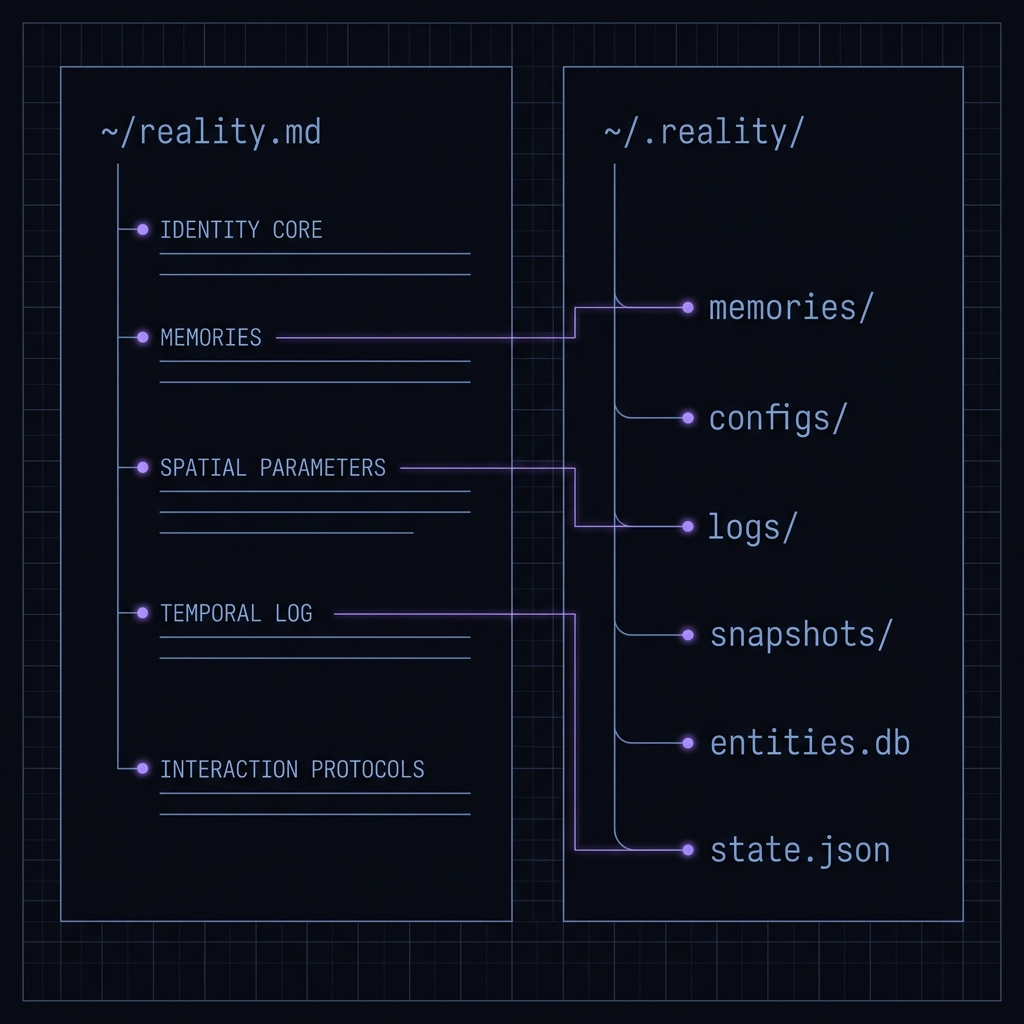
Eight sections, eight levers
Each section is an intervention point on the one chain outcomes actually flow through: attention → belief → action → environment → feedback → outcome. An empty section isn't a failure — it's your gap, found. (The assessment tells you which one.)
Who is acting — the roles every action votes for.
What's being built. Specific, written, with if-then triggers.
What signal agents surface to you, and what they mute.
The conditions you act from — sleep, deep-work windows, non-negotiables.
What is already systemized: agents, supervised automations, and review loops.
The defaults you've engineered. What's been removed.
Review cadence and the metrics that count.
What agents must never do on your behalf.
The agent protocol — five verbs
What makes this a standard rather than a note: any agent that finds your reality.md knows exactly how to behave.
- 1READ — Load reality.md before acting on the human's behalf.
- 2SURFACE — Filter inputs against Aims and Attention — signal forward, noise muted.
- 3PROPOSE — Recommend the smallest next action that votes for the Identity.
- 4LOG — Append outcomes to .reality/ — wins, reviews, never silently.
- 5GUARD — Refuse anything that violates the Guardrails.
Adopt it in two minutes
- 1. Copy the template from the repo into
~/reality.mdand fill what you know. Leave the rest empty — empty is a map. - 2. Add one line to your harness's instruction file (CLAUDE.md, .cursorrules, GEMINI.md):Read ~/reality.md before acting on my goals; follow its agent protocol.
- 3. Ask your agent: "Read my reality.md. What's the smallest next action?" — and watch it answer like it knows you. Because now it does.
The spec is MIT — extend it, fork it, build tools on it. The name stays generic on purpose: standards survive their authors. The method that fills the file is the Architect's Loop, and it's free too.
Get the reality.md field guide
The full walkthrough for filling all eight sections — with the agent prompts that maintain it for you.